
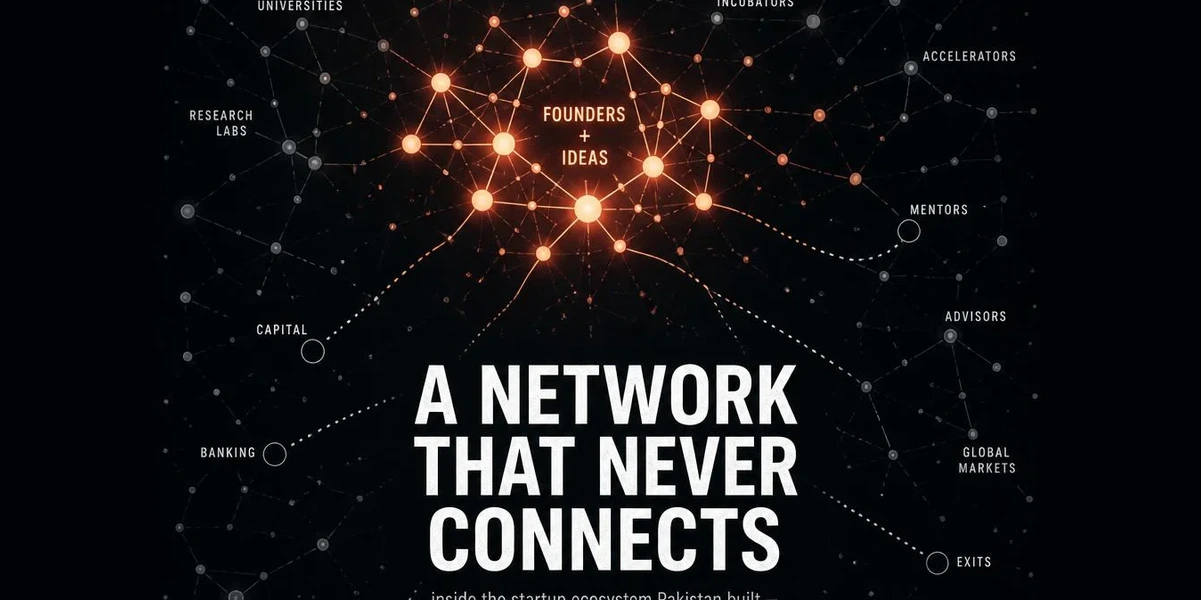
Pakistan now counts more than 1,100 startups by some rankings and at least 800 by others. So the appetite to build something new is clearly there. Yet ask most young Pakistanis what “starting a business” means. The answer is usually still a food cart, a mobile repair shop, or a small trading venture. Genuine innovation-led startups remain the exception. Here’s why. And here’s what would actually change it.
The Ecosystem Exists — It Just Doesn’t Connect
The raw ingredients for a startup boom are already in place. There’s high digital demand, public support mechanisms, growing founder density in major cities, and rising investor curiosity. But something is missing. Specifically, the pieces that turn an idea into a scaled company: late-stage capital, real exits, cleaner support systems, and stronger founder infrastructure.
Regulation compounds the gap. According to the Pakistan Startup Ecosystem Report 2024, the regulatory framework remains fragmented across multiple agencies, creating unnecessary complexity for entrepreneurs. Consider a founder registering a company, opening a bank account, and filing taxes. Often, that means dealing with three separate systems that don’t talk to each other. As a result, this friction pushes risk-averse graduates toward a shop instead of a scalable idea.
Money has been just as inconsistent. Startup funding fell 77% in 2023 compared to 2022, driven by macroeconomic instability, high inflation, a dollar liquidity crisis, and high global interest rates. When capital vanishes that fast, the lesson lands quickly. Families and universities pass it on: startups are a gamble, but a small shop is not.
The Signs of a Turnaround
Still, the picture isn’t static.Local startups raised over $74 million in 2025. Then, by March 2026, they had already raised $93.5 million across five equity rounds. Most of that money went to fintech, healthtech, AI, and B2B SaaS. Meanwhile, Pakistan is also producing founders backed by global firms like a16z and products used by international clients. In other words, the ecosystem is maturing beyond outsourced software work.
Policy is catching up too. The Finance Bill 2026 introduced pass-through taxation for venture capital funds, aligning Pakistan with practices in mature markets like the US and Singapore. As a result, gains now flow directly to investors instead of being taxed twice. That said, not every recent policy has helped. The same year also brought an 18% sales tax on cross-border e-commerce and large domestic platforms, which added fresh compliance costs for early-stage teams.
What Would Actually Shift the Culture
- Make risk-taking teachable, not just admirable. Entrepreneurship needs a real place in university curricula. Students should build a prototype. They should pitch to real investors. They should learn to read a term sheet. A single elective on “business plans” isn’t enough.
- Normalize failure. Most families still treat a failed startup as a permanent mark. But public case studies help. When founders share how they failed once, then built something bigger the second time, culture shifts faster than any government campaign could manage.
- Simplify the regulatory maze. A genuine single-window system would help most. It should cover company registration, tax filing, and IP protection in one place. Not just the promise of one, but the real thing. That alone would remove the biggest reason smart graduates default to a shop instead of a startup.
- Put investors in front of students earlier. Most Pakistani students never meet an actual investor before graduating. So campus demo days matter. When real VCs judge them, students see what’s actually possible.
- Reward IP and product thinking, not just service delivery. Tax incentives and grants should favor teams building a product or platform. Not just another agency reselling services.
Options Beyond the Food Cart
Young Pakistanis weighing their first venture have more real paths than they’re usually shown:
- Tech-enabled services and SaaS — software for local problems (logistics, agri-supply chains, retail POS, healthcare scheduling) with a clear path to expand regionally.
- Freelance-to-founder route — build a skill (design, dev, marketing) on global freelance platforms first, then productize what you learn into a startup.
- Incubators and National Incubation Centers (NICs) — Ignite’s NIC network offers mentorship, workspace, and seed support without giving up equity early.
- Corporate innovation and intrapreneurship — join a bank, telecom, or FMCG innovation lab to build startup skills with a salary safety net.
- Social enterprises — ventures solving education, health, or climate problems, often eligible for grant funding not available to purely commercial startups.
- Export-oriented freelancing collectives — small teams pooling skills to serve international clients directly, skipping the local-market ceiling entirely.
Where the Funding Actually Is
| Source | Best For | Notes |
|---|---|---|
| Ignite – National Technology Fund | Idea to early-stage | Grants and NIC incubation support, government-backed |
| National Incubation Centers (NICs) | Pre-seed teams | Mentorship, workspace, investor access in major cities |
| Angel networks (e.g., Pakistan Angel Investors) | Seed rounds | Smaller checks, faster decisions than VCs |
| Local VC funds (i2i, Sarmayacar, Fatima Gobi, Zayn Capital) | Seed to Series A | Now benefit from pass-through taxation under the Finance Bill 2026, making local funds more competitive |
| International accelerators (Y Combinator, Plug and Play) | High-growth ambitions | Plug and Play has signaled entry into Pakistan’s ecosystem |
| Equity crowdfunding | Small local rounds | Recently simplified via SECP’s IBAN verification for investors |
| Corporate venture arms | Fintech, telecom-adjacent ideas | Banks and telcos increasingly fund startups that extend their platforms |
The Bottom Line
Pakistan’s startup culture isn’t broken. It’s underbuilt. The founders exist. The ideas exist. Increasingly, so does the capital. What’s still missing is simple: a system that makes building a product feel safer, faster, and more rewarded than opening another shop. Close that gap, though, and everything shifts. The “typical business” stops being the safest choice. Instead, it becomes the fallback.
Sources: Pakistan Startup Ecosystem Report 2024 (i2i), StartupBlink Pakistan Rankings (July 2026), Digital Pakistan AI Ecosystem Report (2026), Startup.pk coverage of the Finance Bill 2026 and Budget 2026.