
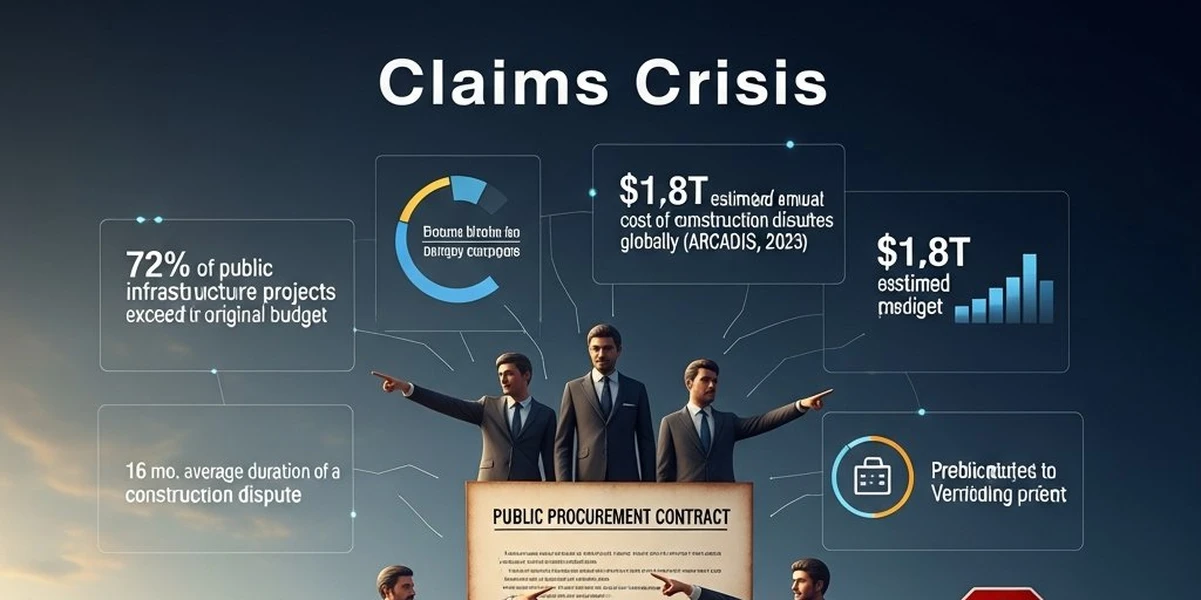
The construction industry is in a “claims crisis.” Cost overruns, stalled projects, years-long disputes. The root cause is rarely discussed openly — and fixing it starts with understanding where things actually break down.
| 72% of public infrastructure projects exceed their original budget | $1.8T estimated annual cost of construction disputes globally (ARCADIS 2023) | 16 mo. average duration of a construction dispute, up from 13 months in 2019 |
What Contract Failures Actually Look Like
Research keeps surfacing the same patterns. The UK National Audit Office (2022) found over 60% of delayed government infrastructure projects cited client-side issues as a primary cause — yet fewer than 1 in 5 formally acknowledged the delay or issued a compensation event.
The World Bank identifies late payment by public clients as the single largest cause of contractor insolvency in public works across sub-Saharan Africa and South Asia — the fastest-growing construction markets.
Recurring failure points:
- Late or withheld payment after certified work
- Delayed designs, permits, or approvals from the client
- Unilateral scope changes never formally documented or compensated
- Failure to hand over sites on schedule
Why Admitting Fault Is Structurally Difficult
- Political accountability — admitting a contract failure invites scrutiny from auditors, legislators, and media
- Institutional rigidity — the official who caused a delay is rarely the one authorized to compensate for it
- Capability gaps — a 2021 CIOB survey found fewer than 30% of public-sector contract managers felt equipped to assess time-extension or variation claims
“The claims are not the problem. They are the symptom. The problem is a culture of denial that turns manageable early-stage issues into multi-year legal battles.”
How Denial Manufactures the Crisis It Complains About
When client-side failures go unacknowledged, contractors front-load risk into future bids — driving up prices for everyone. They turn to formal dispute mechanisms that freeze timelines, and stop flagging problems early because experience teaches them that early warning leads to blame, not resolution.
| 3–4× cost of resolving a claim at litigation vs. early negotiation | 68% of claims stem from employer-caused events (RICS 2022) | 40% of disputes avoidable with better contract administration (KPMG 2021) |
| 🇵🇰 PAKISTAN IN FOCUS A Case Study in High-Stakes Procurement Pakistan’s first Construction Disputes Report (PCDR 2022) found the top three causes of disputes to be payment delay, restricted site access, and unprofessional conduct by client representatives — all operational, all addressable. CPEC ($62B originally) has made these failures visible at the highest strategic level. Chinese independent power producers accumulated Rs 475bn in outstanding dues by 2024. Port Qasim Power Project alone reported Rs 85.5bn in arrears as of December 2025, with delays over six months triggering sovereign-guarantee warnings. The $6.8bn ML-1 railway upgrade has stalled indefinitely — analysts at the Stimson Center tie China’s CPEC 2.0 reassessment directly to chronic payment delays. Rs 475bn owed to CPEC power producers (2024) >6 mo. average CPEC payment delay (2025) $6.8bn ML-1 railway, stalled |
The Domestic Picture: NHA and PSDP Diversions
Pakistan’s National Highway Authority has faced repeated contractor stoppages after failing to release allocated PSDP funds — in one case, contractors halted a Rs 110bn project after the Finance Ministry diverted construction funds to service NHA debt. Academic research points to inadequate design documentation and delayed funding release as primary drivers.
Governments That Got It Right
- 🇸🇬 Singapore — mandatory Early Warning Notices (2020) require client-side delays to be flagged before they escalate
- 🇬🇧 United Kingdom — Construction Act mandates fast-track adjudication, cutting resolution from 18 months to under 60 days
- 🇳🇴 Norway — Statsbygg resolved 84% of contractor grievances without formal dispute (2022) via embedded pre-claim panels
Practical Steps for Any Procurement Agency
- Document client-caused delays formally and in real time — not after a claim is filed
- Train contract managers in claims assessment, entitlement analysis, and variation pricing
- Create shared early-warning registers where both parties sign off on delay events as they occur
- Establish fast-track internal compensation panels for claims below a set threshold
- Treat settled claims as data — track root causes and fix upstream failures before the next project
What Pakistan’s Own Research Recommends
PCDR recommends a culture of amicable dispute resolution, better ADR infrastructure, and structured early-warning mechanisms. Pakistan has ADR centres in Lahore, Islamabad, and Karachi, but public-sector use remains low, hampered by frequent invocation of state immunity. Real reform needs legislative change limiting state immunity in commercial construction disputes, paired with mandatory payment-tracking registers at agencies like NHA and the Ministry of Housing.
A McKinsey analysis across 45 countries found projects with robust owner-side contract management had dispute rates 60% lower than those without.
The “crisis” in construction contracting is real — but it’s a crisis of management, accountability, and institutional culture, not contractor opportunism. Fixing it starts with something deceptively simple:
“We caused this, and we will make it right.”
Said on the record, early enough to matter — that’s where reform begins.
Sources: ARCADIS 2023 · RICS 2022 · KPMG 2021 · World Bank · PCDR 2022 (MK Consultus / Currie & Brown) · Stimson Center · Oxford Saïd Business School (Flyvbjerg 2023) · Business Recorder Dec 2025
#PublicProcurement #Construction #CPEC #Pakistan #Infrastructure #ContractManagement #ClaimsManagement #DisputeResolution #NHA #ADR