
A landmark sovereign bond sale signals renewed investor confidence. Here’s what it could mean for project sponsors and PPP financing costs
By Levant.pk Advisory Team | September 5, 2026 | 5 min read
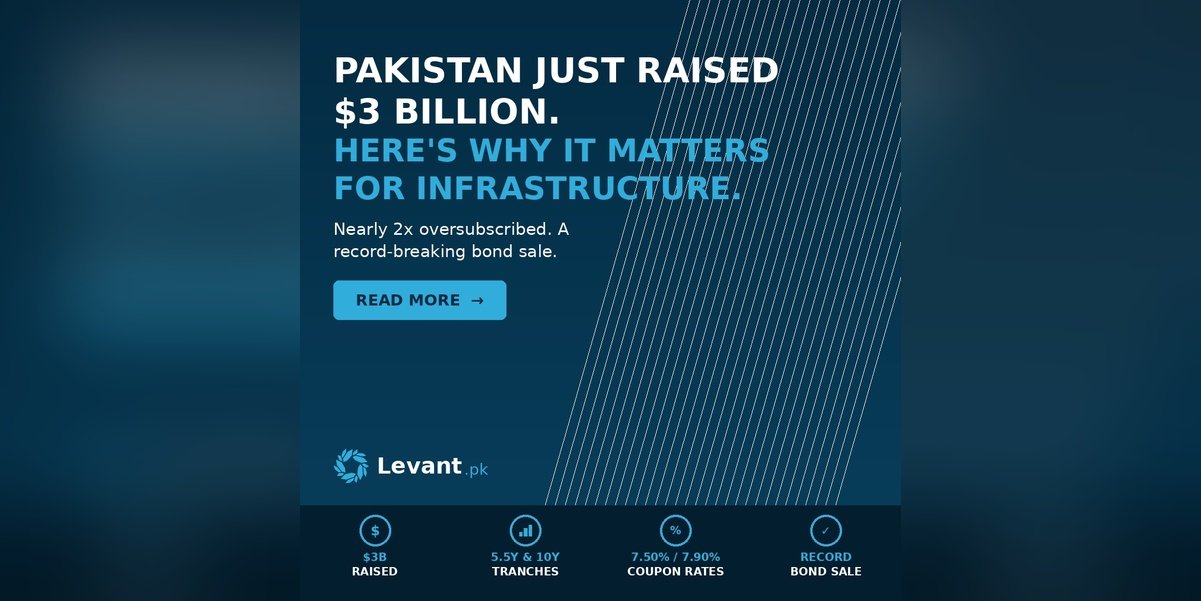
ISLAMABAD — Pakistan raised $3 billion through a dual-tranche Eurobond on September 3. This marks the country’s largest-ever single international bond transaction. The offer drew nearly $6 billion in orders — almost double the amount on sale. For a country that came close to default just three years ago, this is a meaningful signal.
The Deal, in Brief
The Ministry of Finance structured the sale across two maturities. It raised $1.75 billion through a 5.5-year bond at a 7.50% coupon, and $1.25 billion through a 10-year bond at 7.90%. Notably, investor demand for the longer tranche stood out. That matters because long-dated appetite usually signals real confidence, not just short-term yield-chasing.
This was also the first issuance under Pakistan’s renewed Global Medium-Term Note (GMTN) programme. In addition, it follows the country’s inaugural Panda Bond earlier this year and a string of sovereign credit rating upgrades. Citi, Deutsche Bank, Emirates NBD, MUFG, and Standard Chartered acted as joint bookrunners.
Why the Government Is Calling This “Liability Management”
Officials framed this deal as more than just fresh borrowing. Instead, they describe the goal as active sovereign liability management: diversifying financing sources, extending maturities, and reducing rollover risk. In plain terms, Pakistan wants to swap short-term, expensive domestic debt for longer-term, cheaper external debt where it makes sense to do so.
Finance Minister Muhammad Aurangzeb called the transaction a positive development. He linked it to broader reform progress, including successive sovereign rating upgrades from Fitch, Moody’s, and S&P. He made these remarks at a dialogue on taxation for fiscal sustainability that ADB organized. Overall, his comments added useful context: markets are responding to a reform story, not just a one-off bond sale.
What This Means for Infrastructure and PPP Financing
For project sponsors and investors watching Pakistan’s infrastructure pipeline, this deal matters beyond the headline number. In fact, three implications stand out.
First, a successful sovereign issuance at these coupon levels sets a pricing benchmark. Quasi-sovereign and large private issuers, including infrastructure and PPP-linked financing, tend to price at a spread above the sovereign curve. Therefore, a tighter sovereign benchmark generally supports better pricing for well-structured infrastructure debt down the line.
Second, nearly $6 billion in demand from institutional investors across Asia, Europe, and the Americas signals that international capital is willing to look past Pakistan-specific risk again. As a result, that matters directly for LCS clients pursuing PPP structures that rely on foreign lender or investor participation.
Third, and perhaps most practically, fiscal space could open up for public co-investment in PPP projects, guarantees, and viability gap funding as the government retires expensive short-term domestic debt. This isn’t guaranteed. However, it’s the direction the reform narrative points.
The Caveat
That said, one successful bond sale does not fix Pakistan’s underlying fiscal challenges. Tax-to-GDP ratios remain low by regional standards. Meanwhile, structural reform, export competitiveness, and productivity gains still need to materialize to sustain this investor confidence. For this reason, sponsors evaluating Pakistan-linked infrastructure deals should treat this as a positive signal, not a settled outcome.
Frequently Asked Questions
What is a Eurobond?
Issuers sell Eurobonds in a currency other than their home currency, typically to international investors. Pakistan issued its bond in US dollars.
How much did Pakistan raise, and at what rates?
Pakistan raised $1.75 billion at a 5.5-year maturity (7.50% coupon) and $1.25 billion at a 10-year maturity (7.90% coupon), for a combined $3 billion.
How does this affect PPP and infrastructure financing?
A successful sovereign issuance can tighten pricing benchmarks for infrastructure debt and signals renewed international investor appetite for Pakistan-linked risk, both relevant for project sponsors structuring PPP financing.
Related Coverage on Levant.pk
- Govt Reaffirms Commitment to PPPs and Privatisation, Launches Pakistan PPP Monitor (internal link — update URL)
- Pakistan Asks ADB for More Funding for $10 Billion ML-1 Project (internal link — update URL)
- ADB Approves $400 Million Facility for Border Crossing Upgrades in Pakistan (internal link — update URL)
Sources: Business Recorder — Pakistan raises $3bn through Eurobond sale · The Express Tribune — Pakistan raises $3b through Eurobond · Nukta — Pakistan raises record USD 3 billion in largest-ever dual-tranche Eurobond issuance