
Policy Analysis · 2026
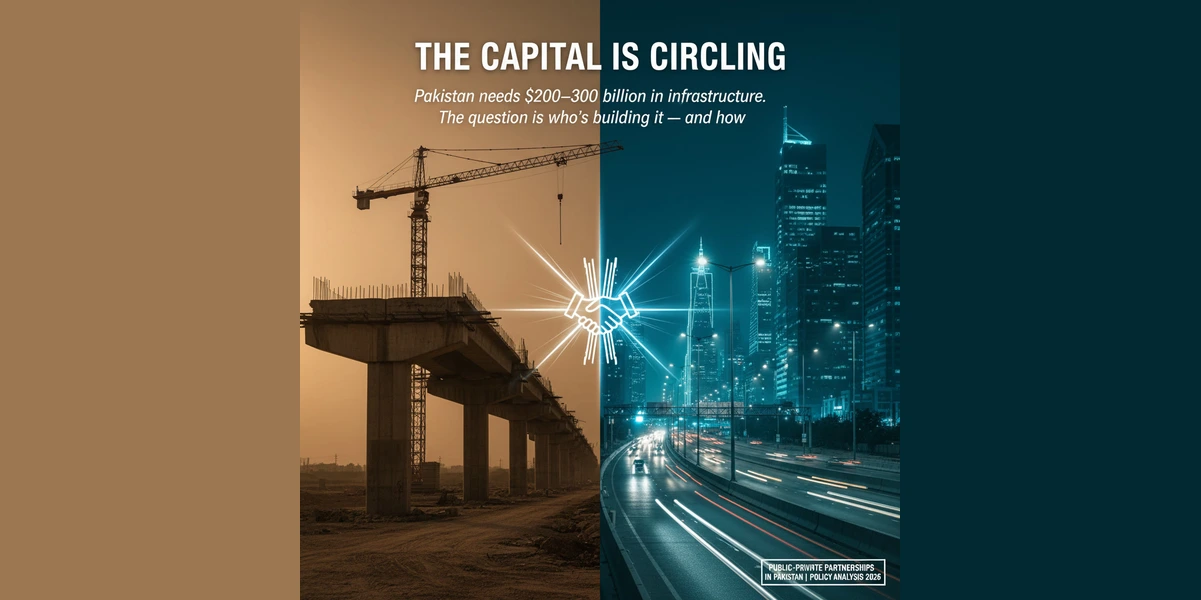
Governments can’t build everything alone. Private capital can’t find yield without stability. That’s where Public-Private Partnerships in Pakistan sit — at the exact intersection of a state that can’t afford to build and investors who need somewhere stable to put their money. Pakistan needs $200–300 billion in infrastructure over the next decade. It doesn’t have that kind of money sitting in the treasury. What it has is a fiscal squeeze, a young population, and a geography investors want. PPPs are how those two realities meet.
What Exactly Is a PPP?
A government can’t afford to build something essential. So it strikes a deal with a private party that can. In exchange, that private party gets a long-term revenue stream. That’s the whole idea.
It isn’t complicated. It’s just structured finance that puts the right risks with the right parties.
- Risk. Shared between the public and private sides.
- Reward. Long-term revenue for investors.
- Contracts. Legally binding concession deals that hold both sides to their word.
The Global PPP Market at a Glance
The numbers are large. Annual PPP transactions worldwide now top $350 billion, according to the World Bank’s Private Participation in Infrastructure Database. Asia-Pacific leads at 38% of that total. Latin America follows at 26%. Europe holds 22%. Everyone else splits the remaining 14%.
Three sectors dominate: energy, transport, and water. Together they account for 70% of all PPP investment on the planet.
The Pioneers: Developed Markets
United Kingdom — Invented the Blueprint
The UK’s Private Finance Initiative launched in the early 1990s. Results were mixed. But it gave the rest of the world a working template to build on.
Australia and Canada — Refined the Model
Standardised contracts. Dedicated PPP units. Transparent procurement. Genuine risk transfer. These two countries took the UK’s rough draft and made it work.
United States — Late but Well-Capitalised
Washington came to the table later than most. The 2021 Infrastructure Act opened broadband, clean energy, and water projects to private capital at scale.
Where the Real Action Is: Emerging Markets
India runs over 1,000 PPP projects across roads, ports, airports, and urban services — backed by the World Bank, the Asian Development Bank, and the IFC. Brazil, Indonesia, Kenya, Egypt, and South Africa are all building out their own pipelines too.
Countries that enacted dedicated PPP legislation and invested in project preparation consistently attracted more private capital.
The Investor’s Checklist
What separates markets that attract capital from those that don’t? Six things, consistently:
- Dedicated PPP legislation — clear legal authority and mandate.
- Independent regulatory bodies — insulated from political pressure.
- Standardised contracts — reduces transaction costs.
- Transparent procurement — competitive bidding, disclosed terms.
- Project preparation capacity — feasibility studies and financial modelling.
- Genuine risk transfer — not just cosmetic, but real allocation.
Pakistan’s Infrastructure Gap
Pakistan needs $200–300 billion in infrastructure investment over the next decade. That covers roads and rail, power, water and sanitation, and digital connectivity. The fiscal math is blunt: elevated debt-to-GDP, a narrow tax base, and a budget squeezed between subsidies and debt service. There isn’t room to fund this from the public purse alone.
Public-Private Partnerships in Pakistan: Not a Policy Option, a Fiscal Necessity
Pakistan has real advantages working in its favour. A population of 230 million, growing younger and more urban, creates a 30-year demand curve. Its location at the crossroads of South Asia, Central Asia, and the Middle East is a geography investors prize. And a decade of suppressed demand means enormous pent-up opportunity for the right investor.
The Foundation Already Exists
Pakistan isn’t starting from zero. A PPP Authority, established under a 2017 Act, already functions with a clearer mandate than most regional peers at a similar stage. The M2 and M3 motorways are real infrastructure outcomes, not white-paper promises. Independent Power Producers have already proven Pakistan can attract long-duration private capital. Gwadar Port and CPEC show the country can pull in large-scale external investment when the political will exists. And Punjab and Sindh have their own provincial PPP frameworks building out the ecosystem further.
A Warning Not to Ignore
The energy sector is the cautionary tale. Poorly structured IPP contracts transferred too much risk to the public purse and too little to investors. The result: international lenders turned cautious. This is a theme we’ve explored in depth in our analysis of contract and commercial management in Pakistan — the same structuring failures that drove circular debt in energy also show up across public infrastructure contracting more broadly.
The lesson isn’t that PPPs fail. It’s that bad structuring creates expensive legacies. Rebuilding investor confidence takes three things: acknowledging what went wrong, publicly. Demonstrating change through completed transactions. And honouring agreements — resolving disputes through process, not politics.
Where the Opportunities Sit
Transport and Logistics — Most Immediate Priority
Road concessions on national highways. Private terminal operations at Karachi and Port Qasim. The ML-1 railway upgrade along the CPEC corridor.
Urban Infrastructure — The Sleeper Issue
Water and sanitation in Karachi and Lahore. Waste-to-energy and water treatment. Bus rapid transit, scaling up from pilot programmes.
Digital Infrastructure — Most Underappreciated
Broadband outside major cities remains thin. Pakistan has a young, fast-growing tech population. Connectivity investment pays back through productivity gains.
The Honest Obstacles
- Thin project pipeline. Project preparation — feasibility studies, environmental assessments, financial modelling — stays chronically underfunded.
- Grinding procurement. Investors who go through Pakistani procurement once often don’t come back. Not because of hostility. Because of unpredictability.
- Political continuity. PPP contracts run 20–30 years. Governments change more often than that. No legal drafting fully protects against a future government that finds a contract inconvenient.
- Currency risk. After the rupee’s volatility in 2022–23, dollar-denominated debt looks very different than it used to. Hedging instruments remain limited.
Why the Capital Is Circling
International capital isn’t sentimental. It’s opportunistic. Gulf sovereign wealth funds are looking for stable, long-duration yields beyond hydrocarbons. Multilateral development finance institutions — the World Bank, ADB, IFC — are actively seeking bankable projects in the region. Regional infrastructure investors are drawn to the same demographic demand and geographic positioning that make Pakistan interesting in the first place.
What It Actually Comes Down To
Four things, in sequence: transparent procurement. Capable, independent regulators. Standardised contracts. Disciplined project preparation. Get those right, and the result is more infrastructure, delivered faster, at better value.
Pakistan has the ingredients. What it needs is the institutional follow-through to put them together.
5 Key Takeaways
- PPPs are a necessity, not a luxury. Pakistan’s fiscal math leaves no other option at scale.
- The global blueprint works. Legislation, plus institutions, plus project prep, equals private capital.
- Pakistan has real foundations. A PPP Authority, provincial frameworks, and completed projects already exist.
- The energy sector is a warning, not a verdict. Structure determines outcomes.
- The window is open. Gulf funds, DFIs, and regional capital are actively looking. Readiness is the only variable left.
The question is whether Pakistan will be ready when the capital comes looking.
Sources: World Bank PPI Database 2024 · World Economic Forum · OECD PPP Reports · Asian Development Bank · Pakistan PPP Authority · Levant.pk Analysis