
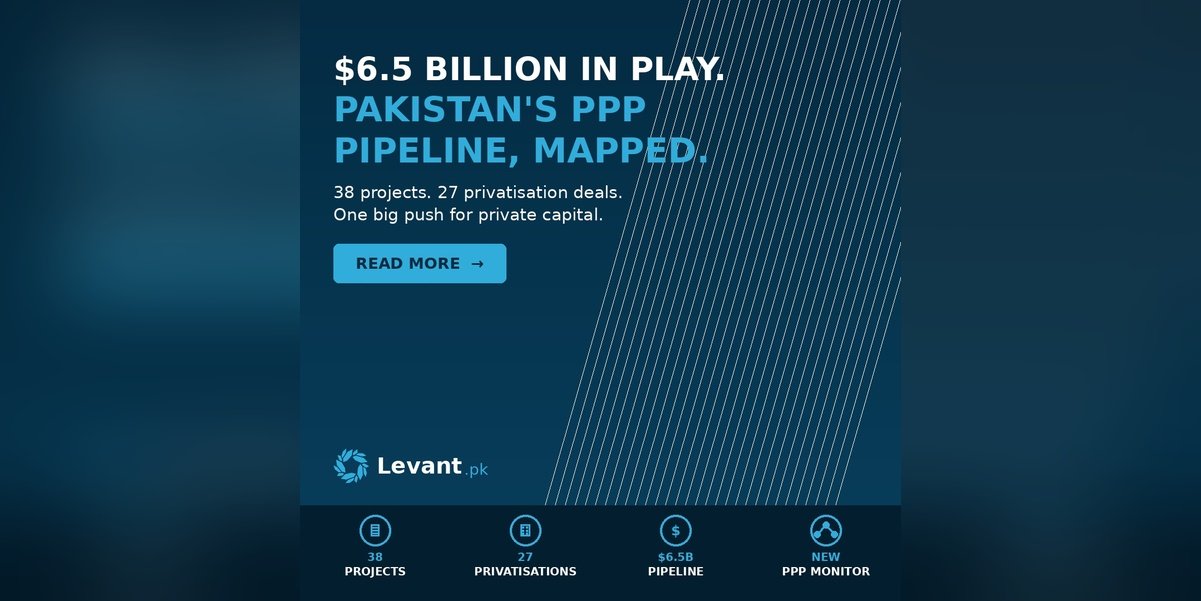
ISLAMABAD — The government reaffirmed its commitment to public-private partnerships (PPPs) and privatisation on September 4. Officials called both key instruments for economic growth. The announcement came at the National Strategic Dialogue on PPPs and Privatisation. Alongside it, the government launched the new Pakistan PPP Monitor. For investors watching Pakistan’s infrastructure space, this is one of the more consequential policy events of the year.
What Was Announced
The dialogue brought together Finance Minister Muhammad Aurangzeb, Adviser to the PM on Privatisation Muhammad Ali, and ADB Vice President Yingming Yang. Senior federal and provincial officials also attended, alongside investors and development partners. Privatisation Commission Secretary Usman Bajwa reaffirmed the government’s commitment to maintaining momentum on both agendas. He pointed to a clear pipeline, coordination, transparency, and a predictable interface for investors.
Two numbers stood out. First, the current federal PPP pipeline comprises 38 projects worth approximately $6.5 billion. These span roads, railways, hospitals, hospitality, aviation, and industrial estates. Second, the Privatisation Commission is working on 27 separate transactions. That list includes power distribution companies, airports, insurance companies, and banks.
Officials pointed to the sale of Pakistan International Airlines (PIA) as proof that the government can follow through on privatisation commitments. Since the 1990s, 154 PPP projects have reached financial close in Pakistan. Together, they represent close to $36 billion in cumulative investment.
The Pakistan PPP Monitor: A New Transparency Tool
The Monitor’s launch matters as much as the pipeline numbers themselves. ADB’s Yang called it an important contribution to improving visibility of Pakistan’s PPP track record. It also improves visibility of the pipeline for investors and other stakeholders. In practice, this means potential sponsors and lenders should now have a single, more reliable reference point for tracking projects. Previously, they had to piece information together from scattered ministry announcements.
Yang also welcomed Pakistan’s broader push. He noted that well-structured PPPs can complement constrained public resources. They also bring private sector efficiency and improve services for citizens. That framing lines up closely with how LCS approaches PPP advisory. The value isn’t just in attracting capital. It’s in structuring contracts and risk allocation so projects actually get built and maintained over their full lifecycle.
What This Means for Investors and Sponsors
For firms evaluating Pakistan-linked infrastructure opportunities, three things are worth tracking closely.
First, the sector spread matters. A $6.5 billion pipeline spans roads, railways, hospitals, hospitality, aviation, and industrial estates. That means opportunities aren’t confined to energy or transport alone. Sponsors with expertise in healthcare or hospitality PPPs may find more room to compete than they’d expect. Many still associate this market only with power and roads.
Second, privatisation and PPPs are being pursued in parallel, not sequentially. The 27 privatisation transactions include power distribution companies and airports. This suggests the government sees outright asset sales and structured PPP partnerships as complementary tools, not competing strategies. That distinction matters for how a sponsor structures its entry into the market.
Third, institutional coordination is explicitly on the agenda. The dialogue highlighted the need for closer coordination across federal and provincial PPP institutions. Historically, that coordination gap has been one of the biggest sources of delay and dispute in Pakistani infrastructure projects. Progress here, even incremental, reduces execution risk for sponsors.
The Caveat
Reaffirmed commitments and new monitoring tools are welcome signals. However, they are not transactions. Pakistan’s PPP and privatisation agendas have faced delays before. A pipeline is only as good as the projects that reach financial close. Sponsors should treat this announcement as a reason to look closely at the pipeline. It’s not a guarantee that any specific project will move quickly.
Frequently Asked Questions
What is the Pakistan PPP Monitor?
It’s a newly launched tracking tool intended to give investors and stakeholders greater visibility into Pakistan’s PPP track record and project pipeline.
How large is Pakistan’s current PPP pipeline?
The federal PPP pipeline comprises 38 projects worth an estimated $6.5 billion, spanning roads, railways, hospitals, hospitality, aviation, and industrial estates.
How many privatisation transactions are underway?
The Privatisation Commission is working on 27 transactions, including power distribution companies, airports, insurance companies, and banks.
Related Coverage on Levant.pk
- Pakistan’s Record $3 Billion Eurobond: What It Means for Infrastructure Financing (internal link — update URL)
- From Talks to Tracks? PM Shehbaz Pushes ADB on ML-1 (internal link — update URL)
- CDWP Clears Rs. 60 Billion in Development Projects (internal link — update URL)
Sources: Business Recorder — Govt reaffirms commitment to mobilising private capital through PPPs & privatisation · Business Recorder — Addressing uplift needs: ADB reaffirms its support for Pakistan’s efforts · Radio Pakistan — Aurangzeb reaffirms Govt’s support for privatization to mobilize private capital